A pastor has become one of the movers and shakers in Malawi’s unregulated gold mining, which has cost a dozen lives in the tobacco-growing district of Kasungu since September this year. What happened for the man of God to cross the line? Our Staff Writer KONDWANI NYONDO writes.
Pastors are no ordinary folks in Malawi, a nation that prides itself as God-fearing.
Unsurprisingly, pastor Absalom, named after the biblical warlike son of King David, commands some respect from his dilapidated church in Kasungu Municipality and at the illegal gold mines in the outskirts.
At Gogodi, 40 kilometres off the M1 in Kasungu East, illegal gold mining has transformed the rural setting and neighbouring Chimbiya into a dangerous, chaotic underworld not for the faint-hearted.
Here, some men of God have traded their collars for gold in pursuit of the precious metal that has left villages in ruins.
However, local miners’ tongues wag about Pastor Harold Abisalomu of Healers of Hope Ministries domiciled in Mbeta at Kasungu Boma.
The man, from Mwanakhu Village inTraditional Authority (T/A) Nkanda in Mulanje, arrived in the tobacco-growing district 2022 as a missionary preacher.
However, he soon pitched a tent at Gogodi, from where he runs his mining operations.
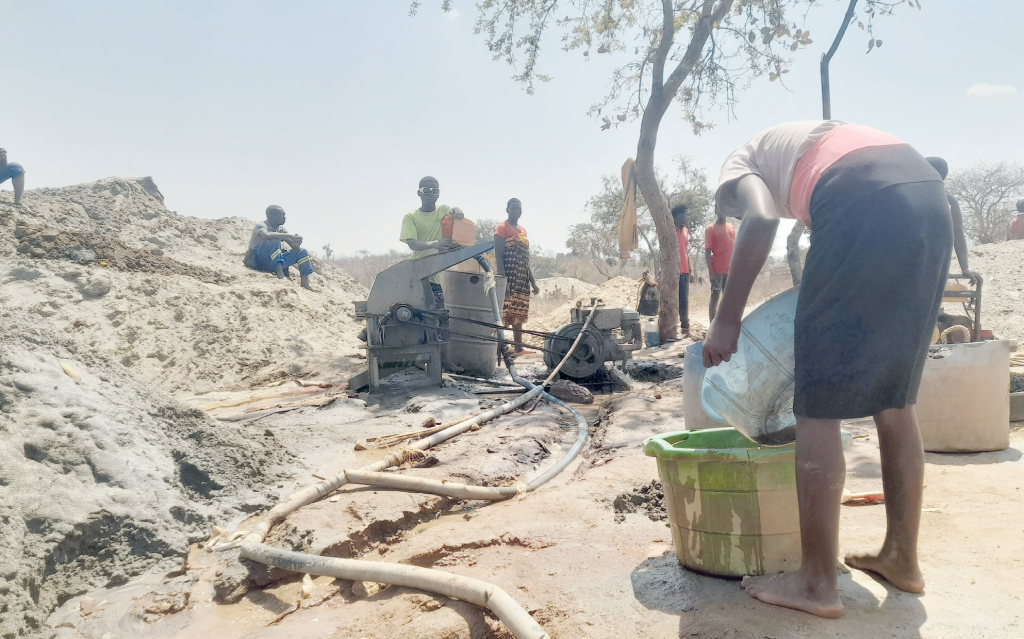
The pastor, who abandoned his church in ruins, boasts expensive mining equipment—a jackhammer, generators and gold mill.
“I co-own the mining equipment with three other pastors,” he said when The Nation visited the mining zone in June.
Locals say Abisalomu and Group Village Head Chimbiya link local miners to powerful individuals, including lawmakers, merchants of Asian descent and a daughter of a former president.
Abisalomu admits meeting a few Asian investors who own most of the gold mining enterprises he coordinates in the area.
“I have been in touch with them and we were negotiating for them to sell us part of their land,” said the pastor behind Zahava Investment.
His mining company rents out equipment to miners and owns mining sites complete with concrete processing tanks worth millions.
When asked how he raised capital for such an investment, pastor Abisalomu said he obtained a loan together with three other pastors. However, he could not name them.
We have never met the said trio in all our three visits to the gold pans of Kasungu.
In a follow-up interview this month, Absalomu said the said pastors pulled out of the investment, leaving him to partner with traditional leaders, most notably Chimbiya.
But Chimbiya denies the involvement of powerful politicians and their business cronies in gold mining, which policy analyst Mavuto Bamusi said chokes or complicates the regulation of the country’s extractive sector.
However, the village head confirmed being Abisalomu’s business partner.
Around them, illegal mining activities flourish, leaving behind tales of environmental degradation, child labour, workers’ exploitation, unsafe tunnels and social disruption.
Collapsing pits and tunnels have claimed 12 lives since September 30, leaving families mourning and traumatised with no regulators to enforce dos and don’ts.
But how did the goldmines-turned-deathtraps start?
“It was in 2023 when some Asians tested the soil and discovered this area was gold-rich. I couldn’t continue preaching the word while others were becoming millionaires,” says Abisalomu.
During the tell-all interview, he kept pointing at a vast stretch that faded into a gray distance.
The allure of gold proved irresistible for the man of God.
He joined the race to the bottom of the gold-rich terrain of Matongwe and Gogodi, which has become a pitted battlefield where only the rich and the strong get richer.
Excavations four times a standard football pitch have replaced homesteads and farmlands, leaving behind mounds of loose soil from tunnels that poke over 20 metres (m) into the ground. Some of the tunnels go 10m deep.
Two years since the locals realised they were sitting on gold, mining persists with no guidance from engineers, environmental protectors, mines regulators and occupation safety specialists.
The Nation visited four other sites with the same pitfalls.
Trees have been cleared without replanting, pits left gaping with fertile land buried in barren rocks.
This contravenes the Environmental Management Act (2017), which birthed the Malawi Environmental Protection Agency (Mepa) to regulate environmentally hazardous activities.
However, the State agency—like the Mines and Minerals Regulatory Authority—claim that it is too underdeveloped, understaffed and underfunded to monitor the ills of illegal mining in rural pockets of the country.
Alarmed by the hidden cost of the gold rush, village head Siliuka of Gogodi area laments: “My worry is that children growing up now will not have anywhere to grow crops.
“We inherited this land from our parents not only for our good, but also the good of our children and their children. How do we expect them to survive?”
Siliuka and T/A Chitantha-Mapiri warn villagers against environmental degradation and selling land to incoming miners, but their warnings often go unheeded.
Siliuka Village is home to at least five illegal mining operations. None are licensed. None have environmental management plans. Milling machines have been set up along riverbanks, where mud and wastewater mixed with mercury—a highly toxic chemical used to extract gold—are released directly into water bodies.
The scene exposes the authorities’ complacency and negligence.
So far, government officials from Capital Hill in Lilongwe and Kasungu District Council only intervene when accidents occur.
When the free-for-all mines cost lives, authorities that find the mining sites hard-to-reach swiftly provide coffins for the dead and grain to feed mourners.
A senior Mepa official said the environmental protectors struggle to investigate the ills of artisanal mining.
“We only have one vehicle. In most cases, we are forced to use personal cars,” said the source.